Excursion tip: Wieskirche, pilgrimage church to the Geisselten Savior

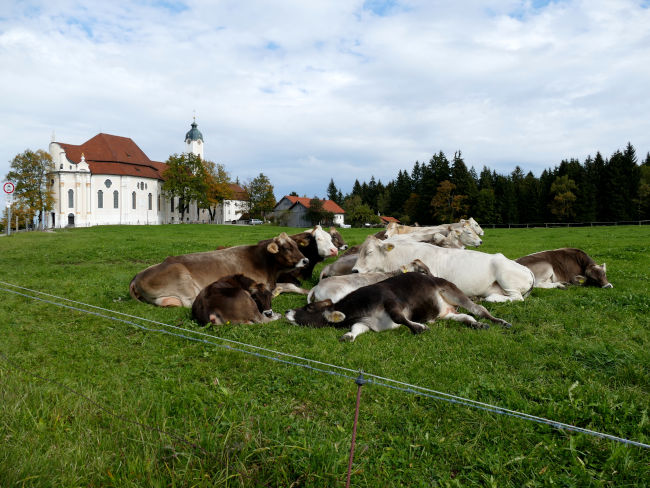
One of the most visited churches in Germany is the Wieskirche with over one million visitors every year from all over the world. And that is no wonder, because the church is truly a beautiful Rococo jewel in a magnificent landscape. It is therefore not surprising that Wieskirche has been on the list of UNESCO World Heritage Sites since 1983.
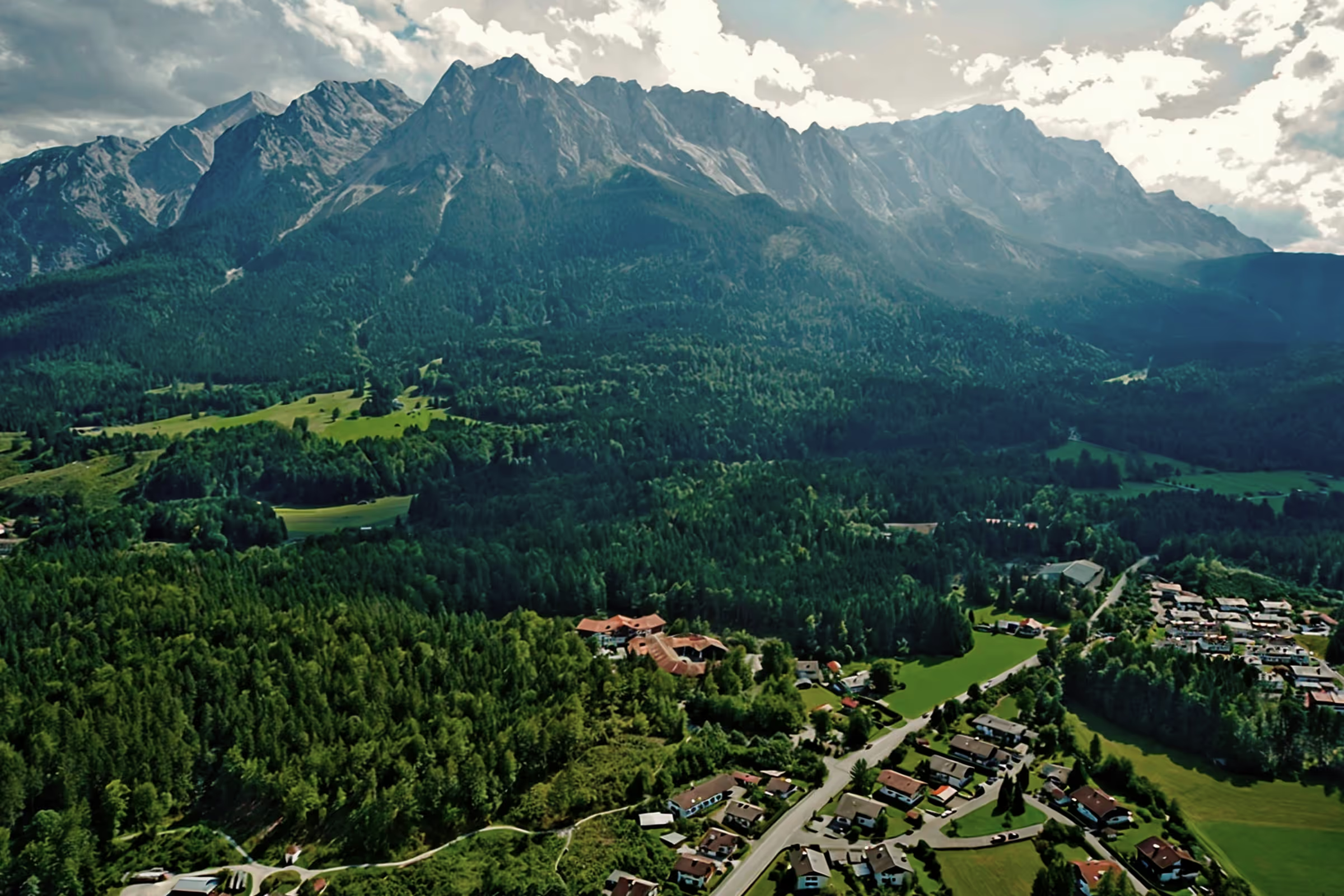
Just about an hour's drive from the Hotel am Badersee, the Wieskirche is surrounded by green countryside near the village of Steingaden in the Pfaffenwinkler region. The Wieskirche is already one of the region's cultural must sees together with Ettal Abbey and Linderhof Castle, as well as the Münter House in Murnau and can be integrated into a daily program in various ways.
Daily program suggestions:
1st Wieskirche Cultural Tour: Important pilgrimage churches in the region
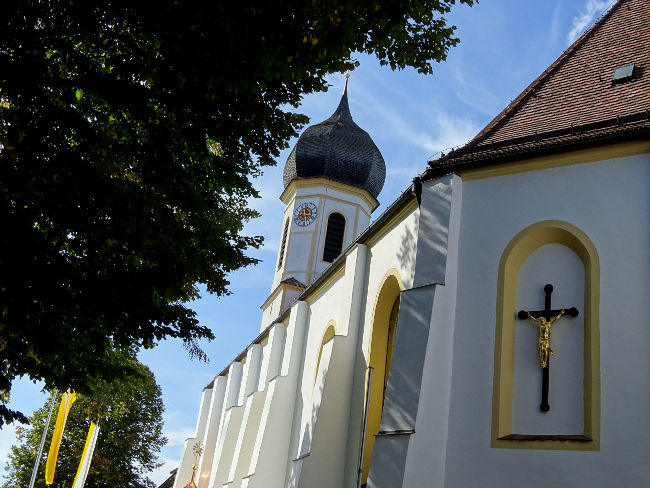
The tour to Ettal starts from the hotel on Lake Badersee, where we first visit Ettal Abbey. Founded in 1330, the imposing Benedictine monastery impresses with its centrepiece, the monastery church of the Assumption of Mary, which is built in Baroque style. The monastery also has a distillery and brewery. There is a monastery shop and you can also visit the cheese factory near the monastery if you wish.
Our trip continues to Wieskirche, which is now extensively admired. There are a few restaurants opposite the church if you want to stop off for lunch. From Wieskirche, the cultural tour continues to Steingaden. This is where the monastery church with its huge, whitewashed towers stands. The construction of the Wieskirche dates back to the monastery. Historians regard the Welfenmünster in Steingaden as an “opened book of art history,” because it combines several architectural styles: Romanesque, Gothic, Baroque, Rococo and Modernism. If time permits, you can also reach Steingaden from the Wieskirche on foot. A beautiful hiking trail through the moor connects the two villages. The hiking trail starts behind the restaurant opposite Wieskirche.
Our final stop is Hohenpeißenberg. Here on the Hoher Peißenberg, there is not only the 17th century pilgrimage church, but also the world's oldest observatory, which was founded by Bavarian Elector Maximilian Joseph III. From the Hoher Peißenberg, you can also enjoy a magnificent view of the Alps; when visibility is good, it is 200 km of alpine panorama!!! The best way to enjoy this is from the terrace of the restaurant on the Hoher Peißenberg with a coffee or dinner. We quickly drive back to the hotel on Lake Badersee via the motorway.
2. Wieskirche on foot: On König-Ludwig-Weg or Brettlweg
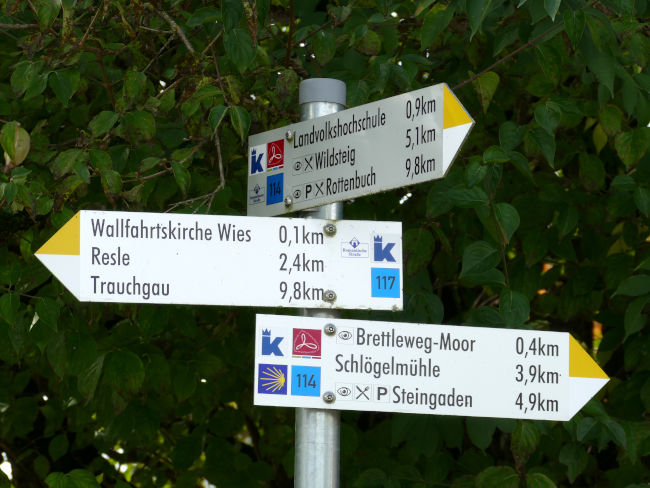
A visit to Wieskirche can be wonderfully integrated into a longer or shorter hiking tour. This is also how you immediately discover the natural beauty of the region. The easiest circular route is Brettlweg between Wies and Steingaden. At 9.6 km, it combines nature and culture.
If you want to discover the extremely interesting landscape of the Pfaffenwinkel more intensively, you can hike on the König-Ludwig-Fernwanderweg. There are two routes available for this purpose. The 20 km long route from Rottenbuch to Trauchgau leads via the Wieskirche. The Wieskirche is about halfway along the way. In total, it takes about 5 to 6 hours to get there. Or you can use the route from Wieskirche via Steingaden until you book. This route is 22 km long and takes around 6.5 hours. Each bus takes you back to the starting point.
The routes can also be wonderfully shortened, for example, you can end the first route at the Wieskirche or you can start at the Wieskirche and run either to Trauchgau or just to Prem. All villages have bus stops for the way back. The trails are well marked with a blue K with a crown above.
3. Wieskirche by bike: Wieskirchen round trips
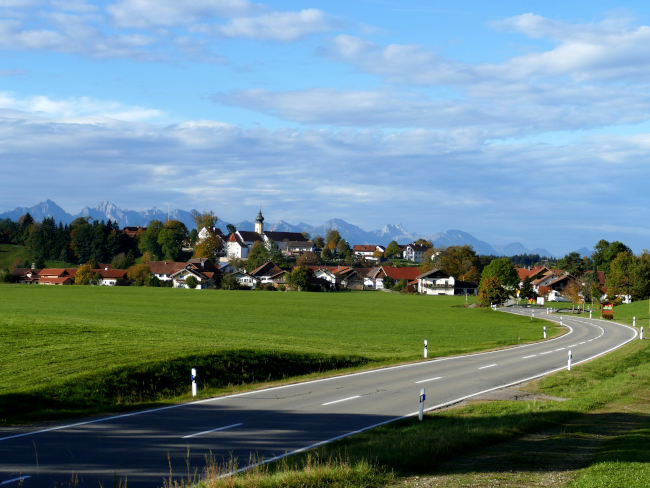
The Wieskirche and the surrounding area are also wonderful to explore by bike. For this purpose, we have made various route suggestions for you. The 25.6 km long and 2-hour journey starts from Altenau train station bicycle tour to Wieskirche. If you don't travel by train, you can park your car at the Dorfweiher Altenau car park. Parking is chargeable.
A 45 km long cycle route leads from Schongau from via Peiting, Rottenbuch, Wildsteig, Wieskirche and also to Steingaden. Here, too, you can easily travel by train.
Another Wieskirche bicycle tour with a length of 42.2 km and a duration of 3.07 hours starts from Oberammergau. Oberammergau is also connected to the railway network. If you still want to take Ettal Abbey along the way, you can extend the bike tour and start from Ettal. However, it is recommended to travel here by car, as Ettal does not have its own train station.
The Wieskirche
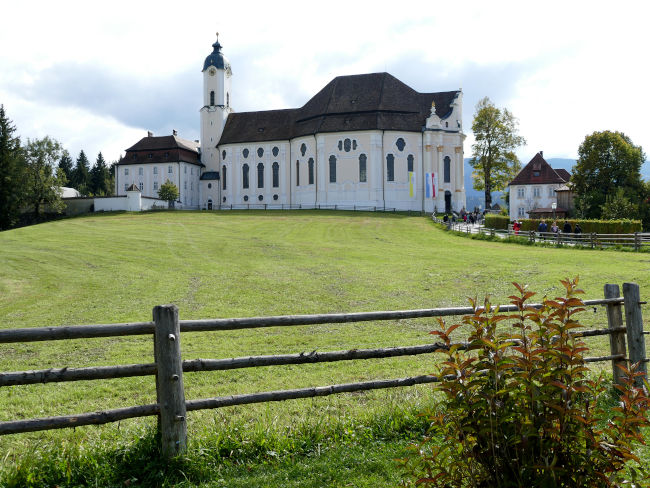
The construction of the Wieskirche dates back to Steingaden Abbey. The character “The Scourged Savior on the Wies” played the decisive role in this. Because it stands for the famous miracle of tears from June 14, 1738. But up to that day, the figure was nothing more than a “pathetic work of art” by two Premonstratensians, Father Magnus Straub and Frater Lucas Schwaiger, from Steingaden Abbey, who made the figure from parts of old figures from the monastery in 1730. The figure lived a truly poor life until his miracle and placement in the Wieskirche. It was carried around during Good Friday processions for just three years from 1732-1734. However, as she was so ugly, she was placed in the clothesroom of the monastery theatre as early as 1735 and then in the attic. Only one believing woman seemed to have no effect on the figure's hideous reputation and so the scholar Maria Lory took on the figure in 1738. And just a few months later, the miracle happened. When Maria Lory discovered drops in the face of the scourged person during evening prayer on June 14, 1738, which she thought were tears, a new cult was born and an unceasing pilgrimage movement emerged.

Photo: www.wieskirche.de
In 1740, the number of pilgrims was already so great that the monastery decided to build a small chapel for the figure of the scourged savior. However, the influx of pilgrims continued to grow and so, just three years later, the order to design a pilgrimage church for the scourged savior on the Wies was awarded by the then abbot Hyacinth Gassner to the town builder of Landsberg, Dominikus Zimmermann. Construction began in 1745, the choir was completed in 1749 and the scourged savior was transferred. Construction continued and the nave was completed in 1754. The last organ to be installed was in 1757.
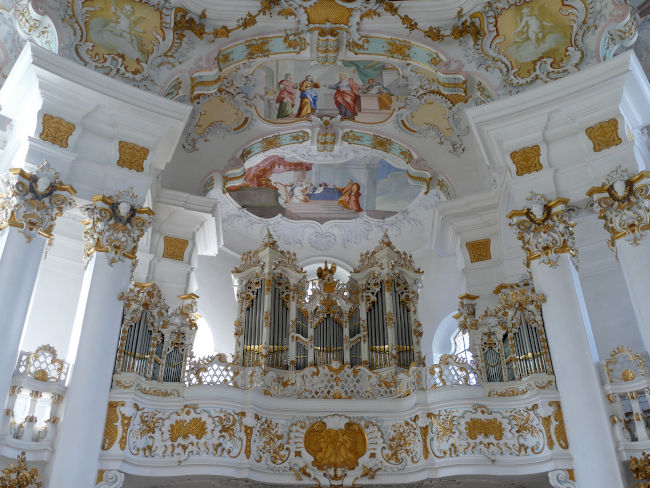
As early as 1809/10, just 55 years after its completion, the fall of the Wieskirche was almost sealed, because as a result of secularization, the church was to be auctioned off and demolished. This was only prevented by decades of persistent efforts by the municipality of Fronreiten and its farmers. Bavaria will thank the people of that time for it to this day, because who would have thought back then that the Wieskirche would be on the list of UNESCO World Heritage Sites in 1983 and would therefore be one of the 8 UNESCO World Heritage Sites in Bavaria.
And so the story shows us once again what can happen as a result of coincidences. The then Premonstratensians and creators of the famous figure would probably never have believed that their artistic work would go from an eyesore to a world-class work of art. And perhaps it was the castigated person's gratitude to Maria Lory who did not see the ugly in him, but the beautiful and thus revealed the miracle to her. It is definitely a great story once again.
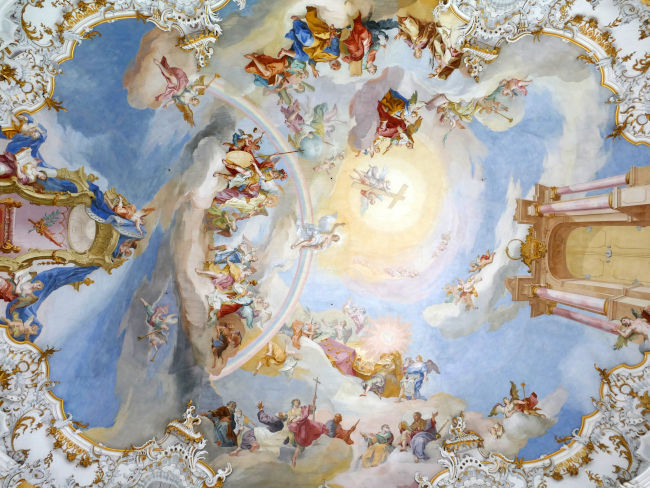
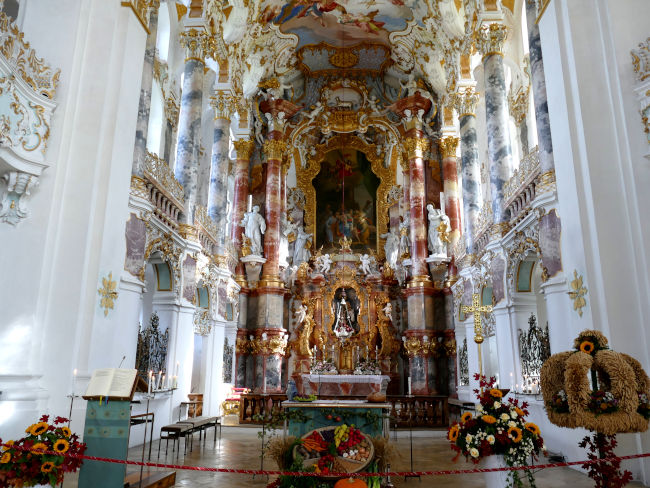
Anyone who enters the church today will be impressed by the artistic wealth and decorative design in Rococo style. Yes, Bavaria's Catholic churches and monasteries spared no expense or effort back then to build true pieces of jewelry and attract visitors from all over the world then and now. The main artists at that time were the Zimmermann brothers, Dominikus and Johann Baptist, who came from the small village of Gaispoint, in the district of Weilheim Schongau. Her talent as a plasterer, marbler and fresco painter took her out of the village all over the world, from France to Poland and Russia. They were the Bavarian export hits of the 18th century.
So take your time during your visit to enjoy the artistic subtleties of the two artists and other designers in peace and quiet.
Tips & info:
- The Wieskirche can also be easily reached by bus from Garmisch-Partenkirchen. Bus 9606 goes from Garmisch-Partenkirchen train station directly to Wieskirche (duration: approx. 1 hour 20 minutes. Be careful: On some trips, the Wieskirche is canceled!). Alternatively, take bus 9606 to Echelsbacher Brücke in Rottenbuch and then continue with bus 9651 to Wieskirche. (Duration approx. 1 hour 50 minutes.)
- If you arrive by car, you will find paid parking spaces opposite the Wieskirche.
- The Wieskirche is always very busy, which is why there is an opening plan with off-peak and peak visiting times as well as closing times. Current information and opening times are available here.
- There are places to stop for refreshments directly opposite the Wieskirche, otherwise in Steingaden. Gasthof Schweiger an der Wies offers good food and an impressive selection of cakes. The historic inn was also built in connection with Maria Lory's family and is worth a visit.
- If you are planning longer hiking tours, such as the stages of the King Ludwig Trail, check out the bus timetables beforehand, as they do not run regularly.
Heartily Wellcome
at Lake Badersee