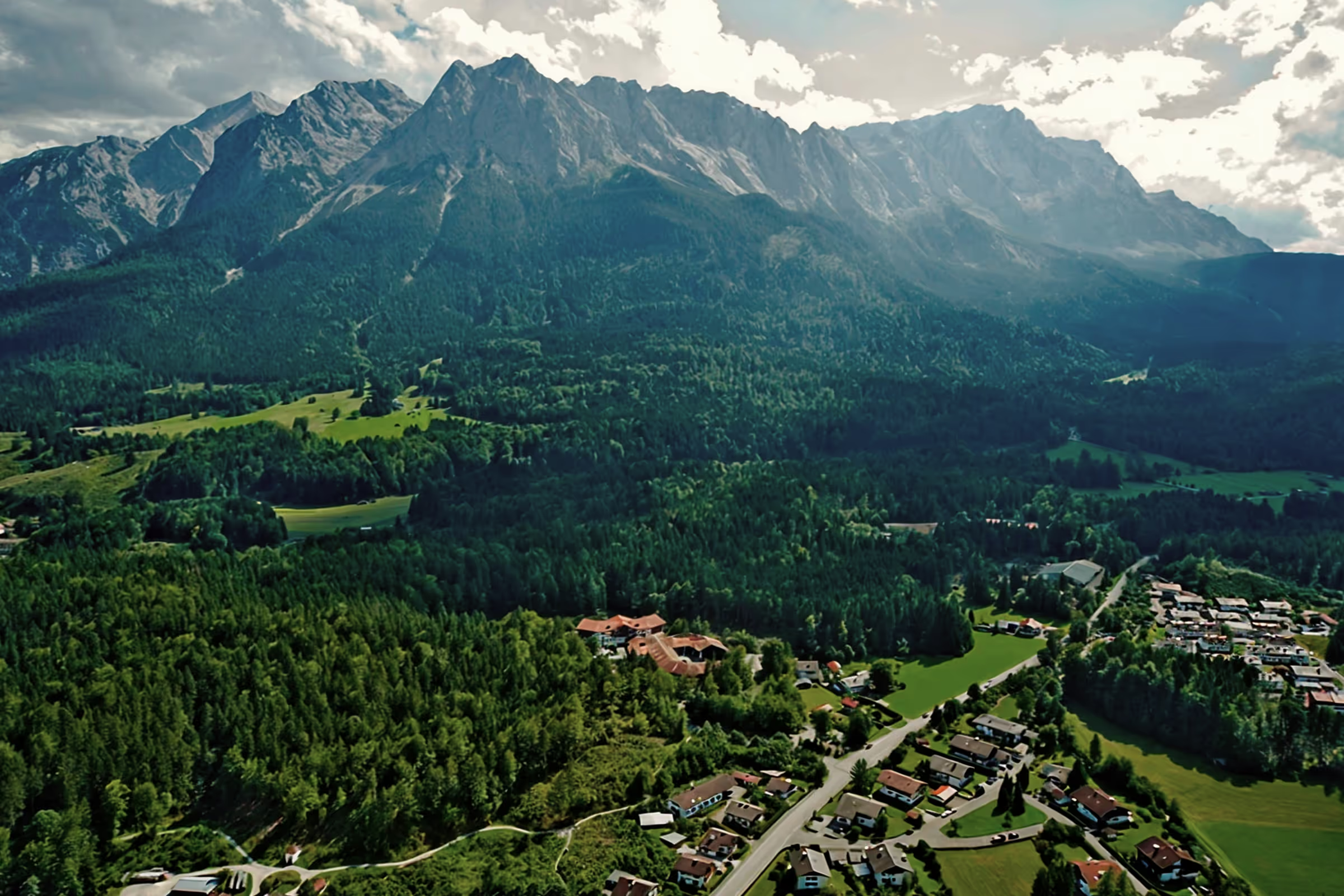
A perfect day in Grainau: ski tour to the Stuibenhütte via Mauerschartenkopf and Stuibenkopf with LVS training

The ski tour to the Stuibenhütte is a popular easy ski tour in the Garmisch-Classic ski area, which is perfect for beginners, or even as a snowshoe hike. A tour to the Stuibenhütte is also easy to combine with a day on the slopes in the Garmisch-Classic ski area or with longer ski tours.
Tour profile
Difficulty level: easy (up to the hut), medium (with wall chart head)
Route length: approx. 4 km (ascent only)
ascents: 150 hm (up to the hut)/450 hm (with wall chart head)
The Stuibenhütte (1,640 m)

In winter, the Stuiben, a small rock massif below the Alpspitze, offers numerous ski touring opportunities. Die Stuibenhütte is intended as a base for winter tourers and is therefore only open during the winter months. Because of its easy accessibility, the route is very popular and is usually busy here, especially on weekends when the weather is nice. You can also stay overnight at the hut (with advance reservation).
The ascent to the Stuibenhütte is from the Bernadein downhill, so this ski tour requires a Garmisch-Classic ski pass (if you still want to spend the day on the slopes) or a tourer ski pass. This last one only includes an ascent with the Alpspitze cable car and a trip with the Bernadein drag lift. The ticket is usually not publicly listed, so you have to ask for it separately at the Alpspitzbahn ticket office.

To reach the starting point, ski down from Osterfelderkopf towards Hochalm until you reach the Bernadein downhill run. Here you turn right. The route starts about 100 m on the right before the Bernadeinlift valley station, and the sign “Stuiben-Bockhütte-Reintal” on the edge of the slopes makes it easy to orient yourself. The trail is well signposted but very busy. From here, it takes about 200 m to reach the Stuibenhütte.

Even though the tour seems to be very easy, you need to be able to stand on your skis for the downhill run: Off-piste skiing is a completely different house number, whether in deep snow, in fog when visibility is limited, in snowfall, or when there is barely any snow left on the track at the end of the season. When there are a lot of visitors, the descent back to the Bernadein lift is often bare and heavily icy during the day.
Warning: Alpine hazards
In winter, ski tourers in the Garmisch-Classic ski area must stay on the designated winter trails and comply with local regulations (e.g. restricted areas). Away from the ski slopes, you absolutely need avalanche equipment. On winter tours, everyone must assess the situation for themselves, even if the tour is considered avalanche proof. If you haven't had any experience with winter tours so far, check out our safety tips:
The Badersee blog: Alps “For Dummies” - safety in the mountains for beginners in winter
On a ski tour to Stuiben
For me, as with many others in Garmisch, the Stuibenhütte was my first ski tour since I decided to do this sport. Since then, I have managed to stop off at least once or twice a winter season at the hut, which can be reached cheaply via several tours. The small hut tour is certainly no longer enough for me, so it will be extended a bit — today with a detour to Mauerschartenkopf and Stuibenkopf.

8:40 AM: On nice winter days, the parking lot at Kreuzeck is quickly occupied. We still manage to get one of the last parking spaces and take the first gondola to Osterfelderkopf. It's still dark in the morning, but the sun should come out later. Below Osterfelderkopf lies an enchanted winter landscape, which in summer wonderful tours but is not accessible in winter due to the risk of avalanches.
9:15 a.m.: Once at Osterfelderkopf, we put on our skis and head towards Hochalm. After the so-called “breakthrough”, where you pass a narrow passage between the high rocks, there is a turnoff to the Bernadein descent a short time later. We drive down it until the ski lift comes into view, then we brake and look for the starting point of our tour on the right side. Fortunately, this is clearly marked with a clearly visible sign. Now it's time to put on the skins.

09:45 o'clock: We test our avalanche equipment first, then the tour can start. The first kilometer is on the plain through the picturesque snow-covered mountain forest. At the early hour, no one meets us on the narrow track, which is already good, otherwise the route is usually busy.

10:30 a.m.: Just before the hut, we take the turn-off to the right. The climb starts from here. A short time later, we are standing on a plateau that offers perfect conditions for our avalanche training planned today.
Search for and rescue victims of avalanches
At the start of the season, it is always good to check and refresh your knowledge again. For example, my fellow tourers today put an LVS device in a backpack and then hide it in deep snow. Now I have to find and remove the backpack with the help of my LVS device, my avalanche shovel and my probe as quickly as possible, but within a maximum of 15 minutes. When rescuing an avalanche, you usually have a maximum of 15 minutes before the victim runs out of air. So switch LVS to search and go.

It would be best to have a real avalanche for training, e.g. old slipped snow, but unfortunately there is none here at this point. The “victim” must also be hidden as deep as possible in the snow — this makes it clear how much strength you need to shovel the snow away in an emergency. The fresh snow on the plateau is of course much lighter than thick avalanche snow, and the search on the plain is also a lot easier than on a steep slope. However, running in deep snow is quite exhausting, right at the Signal search I have to walk several strips around the area. With every step, my legs sink completely. From the moment my beeper picks up the signal from my “victim” for the first time until I manage to precisely locate the hidden backpack, only a few minutes fly by, but I'm completely sweaty by now.

Now it's only 46 meters to my “victim.” At the Rough search However, it sometimes happens that you have to deviate from the straight line. This is due to technical reasons and is due to the curvy “field lines” on which the LVS signal propagates. From time to time, my device picks up the signal from the other tourers who are just passing by, but I can “miss” them with the push of a button (this function is common in many modern LVS devices).

A short time later, my beeper says that the backpack should only be less than 3 m away from me. The device now switches on automatically Fine-search um. From here, I have to move more slowly and guide my LVS directly across the snow surface to reach the point with the shortest distance to the “victim.” After the point is marked with the shovel, you check the exact distance on the snow surface again, then you start with the Point search. This is done with the probe, which is carefully inserted perpendicularly on the surface of the snow, which does not necessarily mean vertical. For example, if an avalanche search takes place on a slope with an inclination of 25 degrees, the probe must accordingly remain 90 degrees to the surface. This is because the LVS shows the shortest distance to the victim, meaning that the victim can lie slightly higher on a slope than expected.

Probing usually goes outwards in a spiral from the point marked with the shovel. The distance to the victim cannot be greater than the value shown on the device, e.g. my device is currently showing a distance of 0.7 m — so it makes no sense for me to stick the probe more than 70 cm into the snow. My first guess was correct and with the second stitch I came across something that is very reminiscent of a backpack. It is of course good to know that it is currently not a person who can be injured with the probe. The avalanche shovel is now being used. Shoveling is the biggest effort when searching for avalanches, especially when the “victim” is deeply buried.
After a successful “rescue”, we practice probing for a short time and try to identify which objects we have just detected with the probe — rocks, wood or frozen soil.
The best way to search for avalanche victims is as a team: in an emergency, you barely manage to rescue one or more people on their own, especially if they are deeply buried. It is therefore advisable to keep the distance between each other even on tour, so that in the worst case, only one person is buried.
More about avalanche victims search
11:30 a.m.: After successful training, we continue through the snow-covered landscape. We will soon be at the foot of the wall chart, to the left is our destination Mauerschartenkopf (1,919 m). The gap is supposedly called that because it is extremely steep. I can confirm that: for the next 45 minutes, we keep climbing in endless sweaty hairpin bends until we stand on a wind-blown bald back. The summit is in sight from here.

12:30 p.m.: The weather today is a mix of sun and clouds. As we reach the summit, the warm rays of sunshine suddenly illuminate us, just in time when we treat ourselves to a tea break after the strenuous climb. Because of its proximity to the Stuibenhütte, the Mauerschartenkopf is very popular on fine days.

Many tourers are just taking a break at the summit and a large group has just arrived from the Stuibenhütte. Space is slowly becoming scarce, so we peel off the skins and drive down. Of course, we make a detour to Stuibenkopf (1,924 m), which is right next door and is relatively easy to climb without major loss of altitude. Over its wide slope, we then drive down to the Stuibenhütte.

1:10 p.m.: The Stuibenhütte is comfortably in front of us, as soon as we get there, we smell the light smoke from the wood stove. However, good alpine cuisine is not to be expected here, as the Stuibenhütte is a self-catering hut. On some days, the landlord has his creative team (he probably gets bored of just sitting in the hut all winter), then there is also pea soup or something similar. In most cases, however, only bottled drinks are offered here, which you pick up yourself outside at the hut window or take them directly out of the crate inside. The locals like to chat with the landlord Jochen, but he speaks such a strong dialect that I barely understand individual words. I'd rather have a look at the hut that way. It is rustic, pretty and traditionally furnished. A special highlight is the outhouse with a large selection of funny posters and photos.

2:20 p.m.: We leave the hut well refreshed. From here, it's straight to the downhill. Although it is not long, it is steep and icy in many places. At the end of the descent, we reach the relatively flat slope through the forest again, which brings us back to the Bernadein ski lift. Here you have to watch out for oncoming traffic. The drag lift brings us back to the Osterfelderkopf - Kreuzeck ski slope, after a few minutes, the Hochalm is over. At Kreuzeck, we continue as normal to the Trögl Tunnel and then via the Kandahar downhill we reach the valley at around 3 pm.
Tips & info:
- Stuibenhütte: Information & opening times. Please note that the Stuibenhütte is a self-catering hut: take enough food and drinks for your tour.
- Alpspitzbahn: Information & opening times
- If you need equipment for your ski trip, WN Alpin is the specialist shop for winter mountaineers in Garmisch-Partenkirchen.
Heartily Wellcome
at Lake Badersee