A perfect day in Grainau: Crossing the Zugspitze
.jpg)
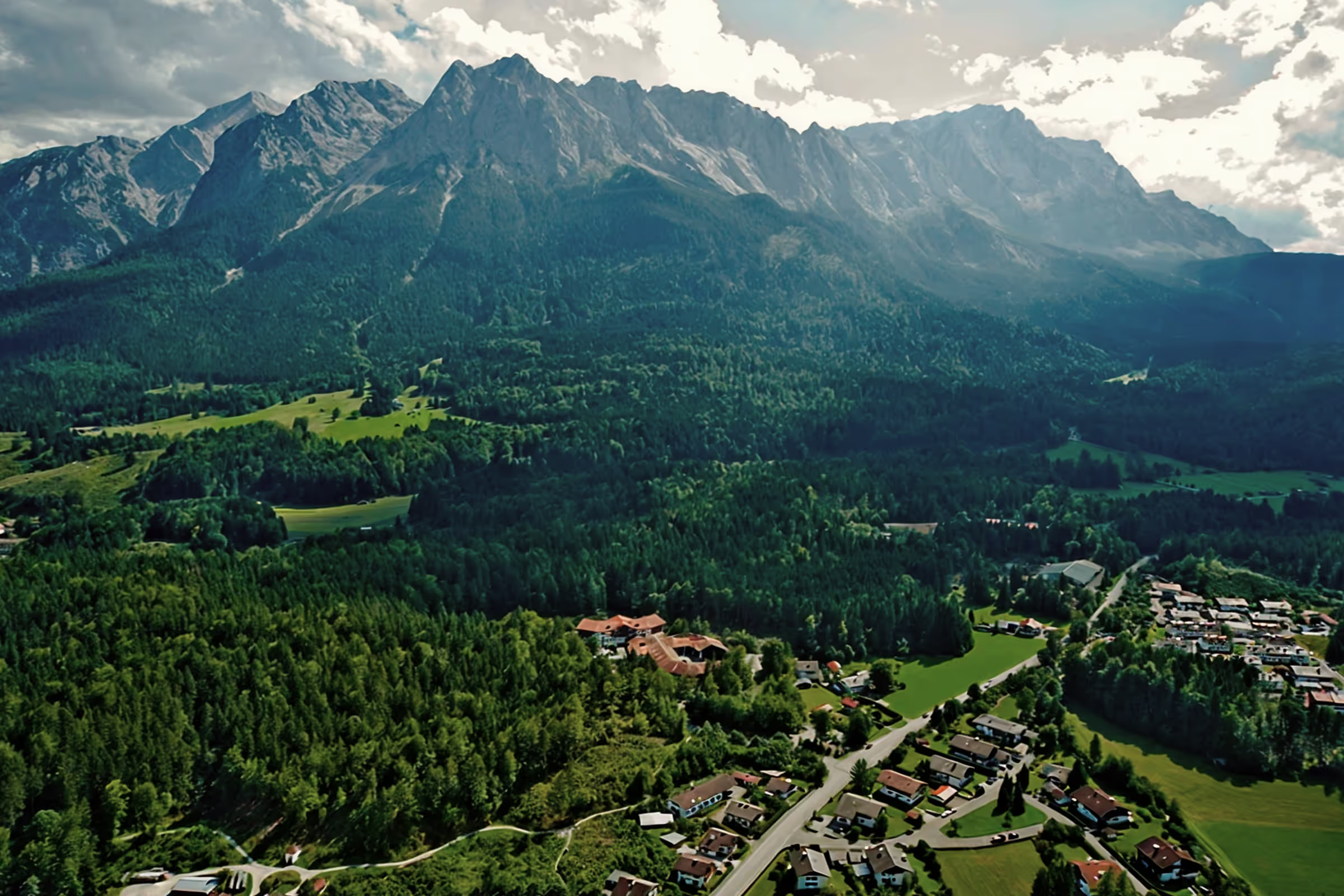
The Zugspitze is Germany's highest mountain, which towers above Grainau and accompanies everyday life in Zugspitze village. For many guests in Grainau, climbing the Zugspitze on foot is a big dream. Even though it won't be the first time for me, today I'm accompanying someone who has ventured their first tour to the Mountain of Mountains.
Tour profile
Difficulty level: difficult
Route length: approx. 20 km
ascents: approx. 2000 m
descents: approx. 2100 m

The times in the text can be used as a reference for experienced mountaineers. Less experienced mountaineers should plan much more time. The tour is only available from mid-June to October and weather permitting. For this tour, it is particularly important to: general Safety tips for mountaineers to note.
Planning & preparation
Climbing the Zugspitze is certainly not possible for everyone. If you want to use the Zugspitze summit as a day trip, you have to be in good physical condition. In its easiest version, the tour has at least 2,000 meters in altitude. Other options require mountaineers to have even more endurance, strength and experience — e.g. the route across Höllental with at least 2,200 m and an additional glacier crossing. So you have to be quite fit and be able to assess your strength well for the mammoth tour. Every year, there are several mountain rescue missions to rescue hikers who have made their way to the Zugspitze summit and bring them back safely back down to the valley. Unfortunately, there is also always fatal accidents.

Overnight stay. Even less experienced mountaineers can realize their dream of climbing the Zugspitze — on a hike lasting several days. Behind the Zugspitze, there are two mountain huts that offer accommodation and food: the Reintalangerhütte (1,366 m) and the Knorrhütte (2,051 m). The two huts are far away from “civilization”, so you spend the first day (or even two days) on the road to reach the hut on a 5-7 hour hike. The summit is not that far away from here and, above all, the climb is not as steep. Experienced mountaineers who no longer make it in one day for various reasons can also go on the Höllentalangerhütte (1.387 m) or at Wiener Neustädter Hütte (2,213 m) stay overnight and continue the hike the next day. All huts have limited capacities, so booking as early as possible is recommended. It is also recommended to book an experienced guide.

mountain railways. Many hikers complete their tour at the summit and take the cable car down to the valley. It must be noted that the Bavarian Zugspitze Railway, the Eibsee cable car And the Tiroler Zugspitze Railway In summer, they are only open until around 5 pm. It is best to check on site when the last descent is. If you miss the last train, you have to descend on foot or stay overnight at the Munich house on the summit or in one of the nearby huts. Unfortunately, it happens time and again that mountaineers on the Zugspitze misjudge their time, have to spend the night outdoors or are evacuated. You often have to pay the costs of a rescue yourself.
The easiest route is via the Stopselzieher — a relatively easy (A/B) but 700 m high via ferrata that connects the Wiener-Neustädter Hütte with the Zugspitze summit. We want to take this route today, starting in Ehrwald. We pack the equipment for the via ferrata, including helmet, via ferrata set and headlamps.
The climb
Even though Sunday in September promises perfect weather and no thunderstorm is in sight, we are on the road early to have more time reserves. The days are not that long anymore and we have to accept that we might need more time than planned due to the length of the route and altitude difference, so we would have to go off with headlamps. At around 7 o'clock we arrived in Ehrwald and park our bikes at the valley station of the Ehrwalder Almbahn, which will be our destination again this evening.

7:00 o'clock: After the parking lot, turn right on a wide forest road. The trail is well marked and passes two signs. Our first stop is the Wiener Neustädter Hütte. After a short time, the trail becomes quite steep and there is a rock on the left with the red inscription “WN Hütte”. Here we turn and are now on a narrow, steep path. The road is full of gravel and will stay that way for the next few hours. This makes the steep sweaty climb even more arduous. The trail only makes a few turns and crosses the Gamskar, where chamois are actually often on the move. Due to avalanches and heavy rain, the trail in the steep Kar region is dilapidated in many places and we must pay attention to every step. If it snows, this section is also dangerous for avalanches.

8:00 a.m.: Shortly after 8 o'clock, we reach the first gap, which offers a wonderful view of Ehrwald and the surrounding mountains. From here, the trail becomes less steep, but more rocky and exposed. Short sections are fitted with a wire rope. After we walk past the Tiroler Zugspitze Railway, an amazing panorama of the Eibsee and Loisach Valley opens up, which accompanies us to the Wiener-Neustädter Hütte.

9:00 a.m.: After approx. 2 hours, we reach the Wiener Neustädter Hütte (2,212 m). As soon as we arrive, several hikers leave the hut who have spent the night here. As with many other high-altitude huts, the furnishings are a bit sparse and the interior doesn't offer much space, so you spend all your time on the terrace. The hut, built in 1883, is supplied by Tiroler Zugspitze Railway. The railway line runs directly above the hut, so the train is stopped and the goods are abseiled down by the gondola with the cable winch for approx. 40 meters. It is a real attraction for passengers, as supply is possible even with normal passenger services.

At the hut, we take a short drinking break and are then ready for the via ferrata. The”Stopper puller“via ferrata through the Austrian Schneekar on the Zugspitze was established as early as 1879 and is classified as easy (A/B). The access to the via ferrata leads through the Kar. It takes about 15 minutes until we get to the start, then we start climbing through a small cave. For experienced climbers, the via ferrata is not particularly demanding — it is the length of the route that comes into play and requires mountaineers to be fit enough for the 1,800 m high route.
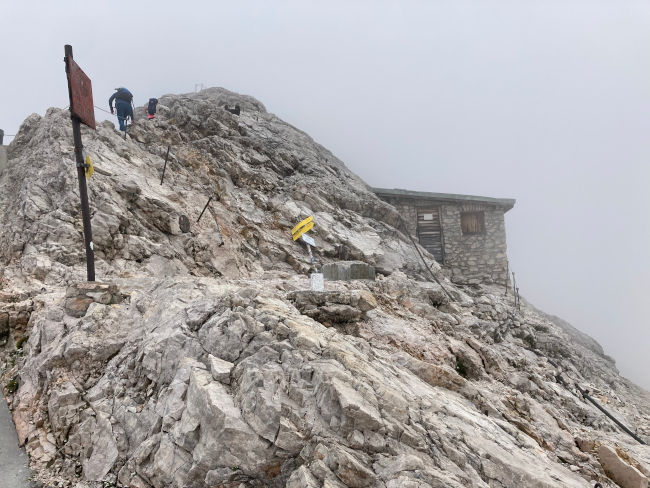
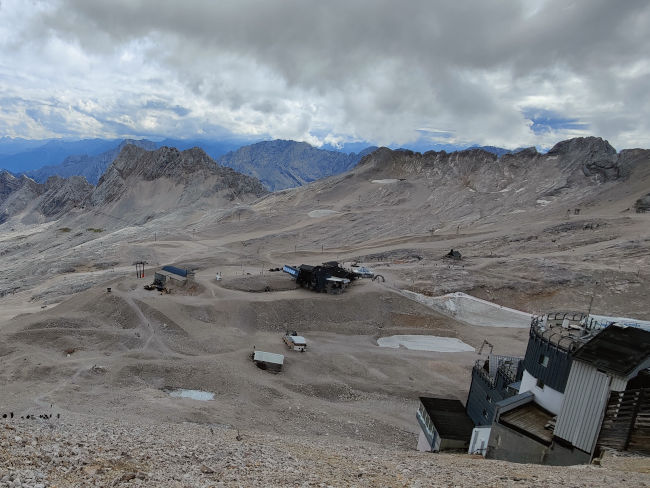
10:00 o'clock: The summit is getting closer and closer. The rope-protected section is over. From here it's time to walk through the gravel again, so we take out our walking sticks again and climb the last few meters of altitude to the Zugspitzkamm, at the abandoned mountain station of the first Tiroler Zugspitze Railway past. The ridge offers a view of the Zugspitzplatt with its ski lifts, which is always magnificently covered with snow in winter and barely visible in summer. Here we take the narrow ridge path to the left towards the Zugspitze summit, which is actually still about 100 m and a good bit further away.
The summit
10:30 a.m.: Only after a 20-minute walk do we reach the summit station. First comes the historical Münchner Haus, which is the highest mountain hut in Germany at 2,959 m above sea level. The house was founded in 1894 and supplemented by a meteorological station in 1900. In the winter of 1900/1901, the meteorologist spent the winter here Josef Enzensperger Alone in the hut for the first time. The Munich house is currently considered a DAV shelter category II and has 30 beds, which are often used as an emergency overnight stay.

We enter the popular Munich House sun terrace, which today offers a wonderful view when the weather is nice, and continue towards the summit cross. Hundreds of tourists meet us here who have gone up on one of the mountain railways. For the first time, we want to take an “honest” summit photo of my buddy, as it is his first ascent of the Zugspitze on foot. We discover that the queue for summit photos is already long and we would have to wait at least half an hour before we get a chance. So we don't take the photos and prefer to go to Restaurant 2962 to quench our thirst and make up for the calorie deficiency after the successful ascent.

11:00 o'clock: Although the restaurant is pretty full at lunchtime, we find a seat at the window with a view of Lake Eibsee and enjoy our early lunch while discussing various routes that we want to go and which are easily visible from here. Then we'll go for a round around the summit station, whose complex architecture doesn't make orientation any easier.
The descent
1:30 p.m.: Then it is time to continue our hike. My companion feels comfortable and would also like to go down on foot instead of taking the gondola down. We are now heading towards Zugspitzplatt and the White Valley. After a long break with good views, we walk from the summit station back along the ridge towards the Stopselzieher and Schneefernerhaus, then take the marked route to the Knorrhütte. The steep 900 m high descent runs through a gravelly landscape set with rocks. Without snow, the high plateau appears unusually grey and bare. Due to the slope, which leads to an increased risk of avalanches, almost no plants grow here. It is all the more beautiful to see a nice little alpine bell in the gravel from time to time.

The historic Schneefernerhaus (2,656 m) is located on the southern flank of the Zugspitze to the right of our route and definitely deserves a separate chapter in our story. Built as a hotel in 1931, the building also initially housed the mountain station of the Bavarian Zugspitze Railway. It was built as a timber structure, the building was rebuilt and rebuilt several times, and the cable cars in the area have been added and changed over time. There was an 800 m long pedestrian tunnel between the hotel and the old Tyrolean cable car, which today is only used for permafrost research. After the Second World War, the Schneefernerhaus was confiscated by the US Army and used as a recreation center. After approval and renovation, the hotel was back in operation from 1952 to 1965. In the severe avalanche accident on May 15, 1965, with 10 deaths and over 20 serious injuries, the hotel building was severely affected by the masses of snow. As a result of the accident, the Bavarian avalanche warning service was founded. From 1988, the new Zugspitze railway station and the Sonnalpin restaurant on Zugspitzplatt were put into operation, as a result of which the Schneefernerhaus partially lost its tourist significance, so the hotel and restaurant were closed in 1992. Since 1999, the Schneefernerhaus has been an environmental research station in which several institutions work together.

2:30 p.m.: After about an hour, we reach Sonnalpin Station with its Zugspitze train station. Here, where skiing starts in winter, snowcats spend their long summer holidays in blazing sun. When crossing Zugspitzplatz, you always have the feeling of being on the moon. The ski lifts also look completely surrealistic without snow. However, the route is quite full: here are hikers who spend the night at the Reintalangerhütte and Knorrhütte and want to climb the Zugspitze the next day. On the left side, the Brunntalgrat with its steep rock flanks is clearly visible — there is a Climbing route From the Knorrhütte to the notorious Jubiläumsgrat. We take our time to explore the plateau and finally reach the Knorrhütte.

3:30 p.m.: The Knorrhütte (2,051 m) has been offering overnight stays for mountaineers since 1855. Built with private donations, the hut was taken over, rebuilt and expanded by the newly founded German Alpine Association. The hut currently has 119 beds and is modernly and sustainably furnished. We go out to the cozy hut terrace and take a longer break again before the 3-hour hike down to the valley begins.

4:30 p.m.: The descent from Knorrhütte to Ehrwald via Gatterl is a 10 km long route, which is easy to walk but can also be exhausting for experienced mountaineers due to its length and the altitude difference already covered. The sun is still high when we leave the hut. Shortly after the start, we pass the lower border of the Zugspitzplatt ski area — here it is again very interesting to see what the places you usually only see with snow look like in summer. For now, the route runs through a picturesque moraine landscape in the Reintal basin. The view of Reintal and back to the Zugspitze and Knorrhütte is simply fantastic.

5:30 p.m.: After about 1 hour, we reach the so-called Zugspitzgatterl, which marks the state border between Bavaria and Tyrol. On the way, you pass the former customs house of the Federal Customs Administration and a memorial with a crossroads. On this trail, shorter ascents add up to a further 200-250 hm. Then it goes downhill towards Hochfelder Alm, where we reach the ski area border and the first ski lifts from the Ehrwalder Alm. Continue on the wide mountain roads and sidewalks towards Ehrwalder Alm. From here, “only” about 400 meters remain to the valley station, where we parked our bikes in the morning. To save time and energy, we take the paved forest road. It goes down quickly and we reach the valley station at dusk.

7:45pm: Our tour ends as planned at the Ehrwalder Almbahn car park. It was over 20 kilometers and about 2,000 meters in altitude, so we are now quite tired and everyone is looking forward to home and their bed. And you can finally take off your hiking boots!
Tips & info:
- Arriving by car: From Hotel am Badersee, take the B23 to Ehrwald. Once in Ehrwald, turn left and immediately left again to the Tiroler Zugspitze Railway. From here, the destination of the hike is over 6 km away, so it is recommended to park a second vehicle (car or bicycle) at the Ehrwalder Almbahn. To do this, you have to drive further through Ehrwald and follow the signs in the town center. Both parking spaces are chargeable. If you only come with one vehicle, you must finally reach the car park on foot (1 to 1.5 hours).
- Arriving by public transport: Unfortunately, it is not possible to travel by public transport at the earlier hour at which the tour should start.
- Equipment & food: On longer tours like this, you should always bring emergency food and enough water, even if there are several huts available along the route. Consistently observe all Safety notes and invest time in preparation.
- mountain huts: Check the opening times, refreshment and possibly accommodation options in advance at Wiener Neustädter Hütte, Münchner Haus, Knorrhütte, Hochfelder Alm, and in Tirolerhaus on the Ehrwalder Alm.
- Downhill ride with the Tiroler Zugspitze Railway: If you feel out of strength at the summit, you can use the Tiroler Zugspitze Railway Drive straight down to the starting point.

Heartily Wellcome
at Lake Badersee