Excursion tip: hiking on Lake Walchensee

Caribbean views, sea monsters, hidden gold treasures and a picturesque way to get to know each other at Walchensee.
Tour profile
Difficulty level: easy
Route length: 6.5 kilometers
ascents: 70 meters
descents: 70 meters
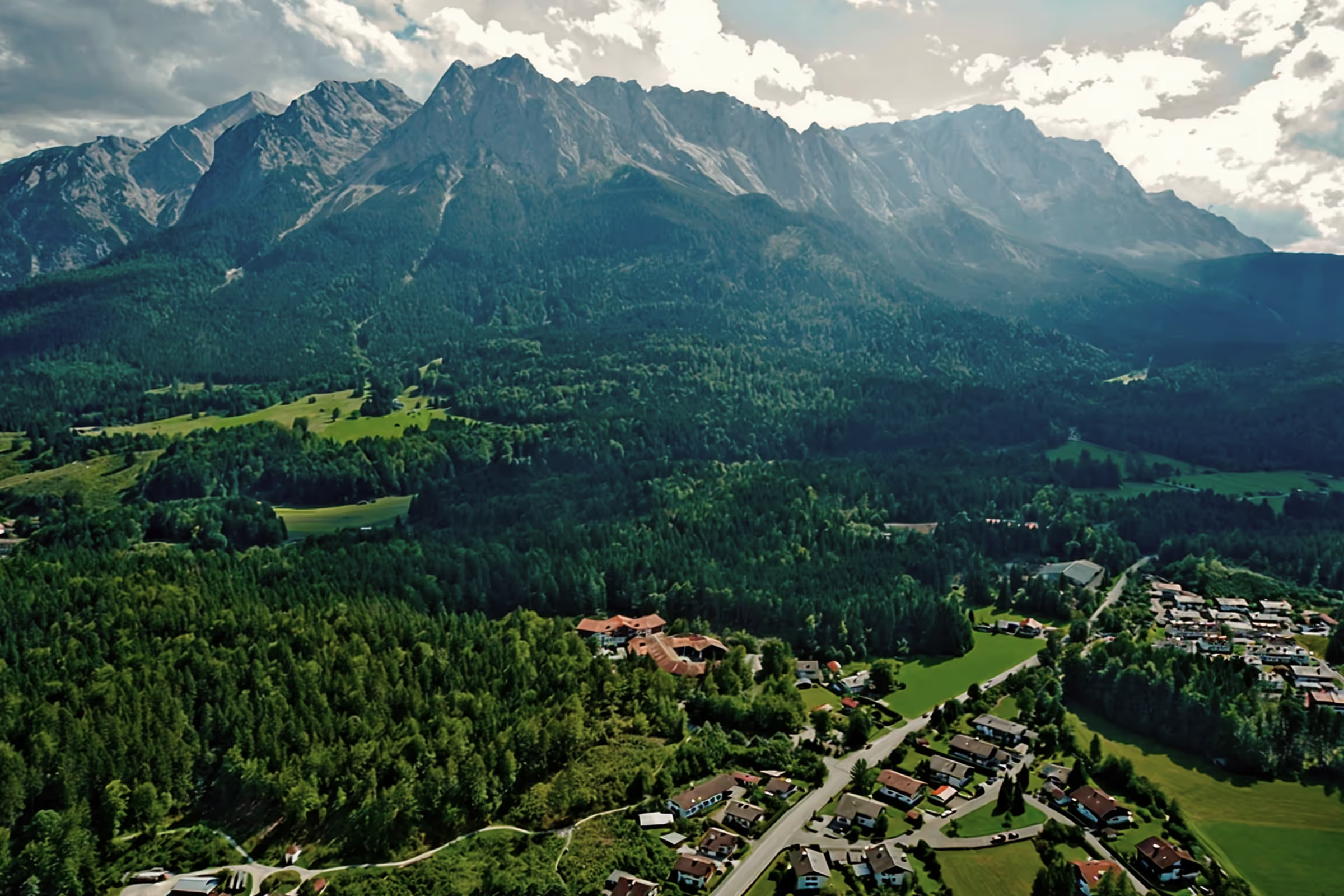
My mother is visiting Grainau again and the weather is at its best. Spring is at its peak, numerous spring flowers are blooming in the meadows, while there is still snow on the highest peaks. On this wonderful day, we will go on a leisurely hike on Lake Walchensee, which is only 37 km from the Hotel am Badersee. After a hearty breakfast, we are ready for our small but nice round at Lake Walchensee in the morning.

Drive first past Garmisch, then Partenkirchen in the direction of Innsbruck to the junction at Krün, where you then take the B11 to Wallgau. At Gasthaus und Strandbad Einsiedl, we park the car, strap on a backpack and set off.

In the morning, the paddleboats are still lined up at the beach, but soon the first guests will arrive to get out onto the lake with the boats. If you want to explore the lake by paddle boat, you need a lot of strength in your legs, because the Walchensee is not only one of the deepest (max. depth 190 m), but also one of the largest (16.40 km²) alpine lakes in Germany. Our trail runs picturesquely along the lakeside for the first hundred meters, then continues straight ahead on the Zwergern peninsula.

On the right and left of the trail, we are enchanted by the meadows, on which hundreds of thousands of different flowers bloom at this time of year, thus forming a colorful carpet. The bright yellow of the yolk flowers is very dominant and glows at us from the horizon. Spring is simply a wonderful time. After winter with its white splendor (this time of year is also fantastically beautiful in the mountains, of course), spring is a revival of nature. Everything looks fresh and new after winter. The bright colors bring joy to life, the warm temperatures make the skin feel good.

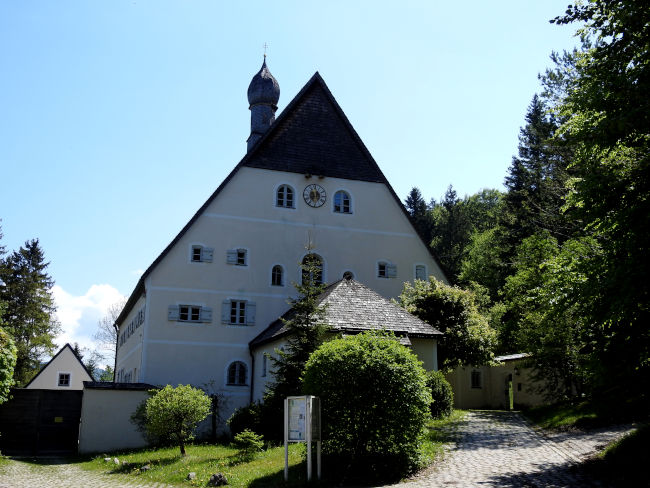
Before we circle the peninsula, it is worth taking a detour to the small chapel of St. Margareth, which stands at the tip of the peninsula. The church was built on behalf of the Augustinian canons of Schlehdorf Abbey and consecrated on 01.08.1344 by a representative of the Bishop of Freising. Holy Mass is to be celebrated here once a month. Around 1670, the church was baroque, the windows were enlarged accordingly and the current altar was erected. The onion tower was added around 1778 during further renovations. During the period of secularization, however, the church was classified as “expendable”, bought at auction on 10.06.1807 by three farmers from dwarfs, on condition that it should not be used as a chapel. However, it wasn't long before services were celebrated again in the small church. This happened in 1819. In 1902, the church was ceded to the Free State of Bavaria by the descendants of the three farmers.

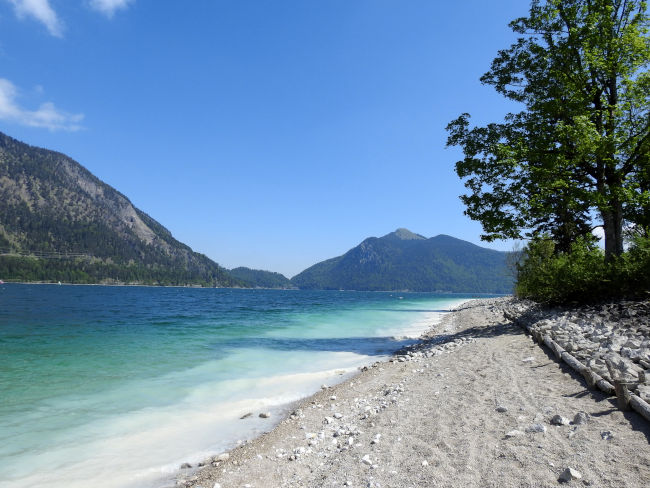
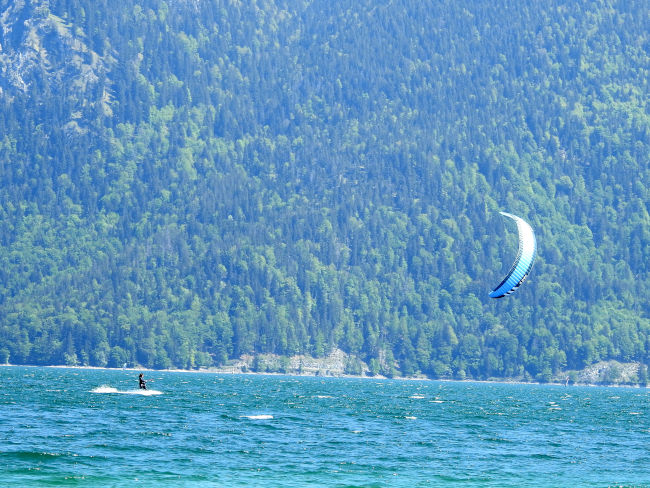
It's pretty windy again close to the shore, to the delight of the numerous kite and wind surfers, for whom Lake Walchensee is a water sports mecca. From the small sandy beach on the edge of the St. Margareth chapel, we watch the water sports enthusiasts for a while. In the strong winds, kite surfers show off their skills with sometimes very high jumps. The fact that Walchensee is also often compared to the Caribbean is due to the turquoise-blue water that spreads out in front of a white sandy beach. If the mountains didn't rise in the background and there were palm trees instead of deciduous trees, then you could really think you were on a Caribbean beach. But we are now separating ourselves from this magical view again, because the wind makes the otherwise warm spring temperatures disappear in no time and goosebumps form on our bare arms.
While locals and visitors today truly enjoy Lake Walchensee as a water sports idyll, especially in the summer months, the former inhabitants of the surrounding villages had more respect and reverence for the lake, because they were convinced that a monster lived at the bottom of the lake. A legend says that Waller's tail was huge and his eyes were as big as wagon wheels. If ungodliness and iniquity were to spread among people, he would pierce the Kesselberg with his tail and flood the entire lowlands as far as Munich. Until the 18th century, it was common practice to sink consecrated gold at the deepest point of the lake to appease the catfish. Obviously with success, because there was never a water breakthrough until the Kesselberg was penetrated by human hands almost 100 years ago. I am sure that the gold is also no longer at the deepest point of the lake. After the Kesselberg was pierced, the belief was probably over and who knows how many dived to the bottom of the lake to recover the gold. But maybe there is still something left, who knows? If you're in the mood, you can dive in and see if you're lucky in the treasure hunt.
But gold was not only sunk in Walchensee in the early centuries, Nazi gold is also said to be hidden here somewhere around Einsiedl. If you type Walchensee in connection with gold on Google, you will find some very interesting articles about this. In April 1945, after Berlin was about to surrender, three transports were sent south in order to secure at least part of the Deutsche Reichsbank's last reserves in the Bavarian mountains around Lake Walchensee, including an estimated 12 tons of gold. Through their efforts and German agents, the Americans found only 9.1 tons. So where the rest went is still speculated today. So who wants to go on a treasure hunt?

Small chapels, paintings of the Virgin and the monastery of St. Anna, on the other hand, bear witness to the Christian past of Walchensee. The Benediktbeuern and Schlehdorf monasteries made the first claims to the Walchensee as early as 740 AD due to the abundance of fish. Until secularization in 1803, the lake was owned by the two monasteries, with Benediktbeuern Abbey having the larger rights. The monastery of St. Anna, which we now pass on our further walk, is a former monastery of the Hieronymites, which was dissolved in 1725 and went to Benediktbeuern Abbey. After secularization, it became the property of the Bavarian state and served as a residential building for the pastor and teacher of Walchensee until the 1960s. In 1979, the Diocese of Augsburg acquired it, had it restored and now uses it as a youth education center. There is not much to see of the former monastery and current youth education center; the chapel can be visited on Sundays during the summer. But since today is not Sunday, it remains closed to us.
Before we reach the village of Walchensee, we have to turn left so that we can get back to our starting point. After a while, we zigzag through a light-flooded forest until we reach the height of Katzenkopf, from which it then descends again and we get along again at Gasthaus Einsiedl. While it was still quite quiet in the morning, the parking lot is now fully parked and, as expected, there are only a few pedal boats left on the boat dock. We are giving our parking space to the next visitors to Lake Walchen and are thinking about where we can now enjoy a delicious lunch with a view on this beautiful day. My mother was extremely satisfied with this tour, which also considered me happy, because it allowed me to present another beautiful region in our area to her.
Tips & info:
- Arriving by car: From Hotel am Badersee, first head towards the train station, then turn right at Rathausplatz and follow the signs for B2 towards Innsbruck. At Krün, take the B11 to Walchensee.
- Arriving by public transport: From the bus stop at the Hotel am Badersee, take the Eibsee bus to the Rathaus stop in Garmisch-Partenkirchen. From there, take bus 9608, which goes to the center of Walchensee (approx. 1:51 travel time, timetable available at www.bahn.de). In this case, you start the described round in the opposite direction.
- Bike tour to Walchensee: You can also easily reach Walchensee from the Hotel am Badersee by e-bike (see blog). E-bikes are available at the hotel.
- parking spaces: The parking spaces at Gasthaus Einsiedl are very limited. Start early accordingly.
- mountain hiking: The Walchensee is the starting point for numerous hikes, including to Heimgarten (1,110 m), Herzogstand (1,290 m), Simetsberg (1,050 m) and Jochberg (720 hm).
- Bathing places Are there in the towns of Walchensee, Urfeld and Einsiedl, on the Zwergern peninsula, between Urfeld and Sachenbach and on the south bank of Walchensee
- boat rental Are there at Gasthaus Einsiedl and in the Walchensee village (also SUP)
- Places to stop for refreshments: There are several restaurants and cafés in the village of Walchensee, and Gasthaus Einsiedl is located at the Einsiedl car park

Heartily Wellcome
at Lake Badersee